
Valuing an Award Flight under Different CPP Definitions
Award travel, such as flights and hotel stays, is a core part of most U.S. credit card rewards programs, and it often delivers more value than redeeming points for statement credits or gift cards. The standard metric for comparing redemptions is CPP, or cents per point: how much cash value one point is worth. However, the CPP of the exact same award can differ drastically depending on how it is defined. 🤔
In this post, I walk through a real example with my calculator to show how I value an award ticket in several ways, side by side.
The example
I chose a Cathay Pacific flight from New York (JFK) to Hong Kong (HKG) on 11/16/2026 for three reasons. Award seats were available in all three cabins that day, so they can be compared directly. The award prices rise almost linearly from cabin to cabin. And Cathay Pacific’s program, Asia Miles, does not transfer 1:1 from the credit card program I use, which shows how transfer terms change the math.
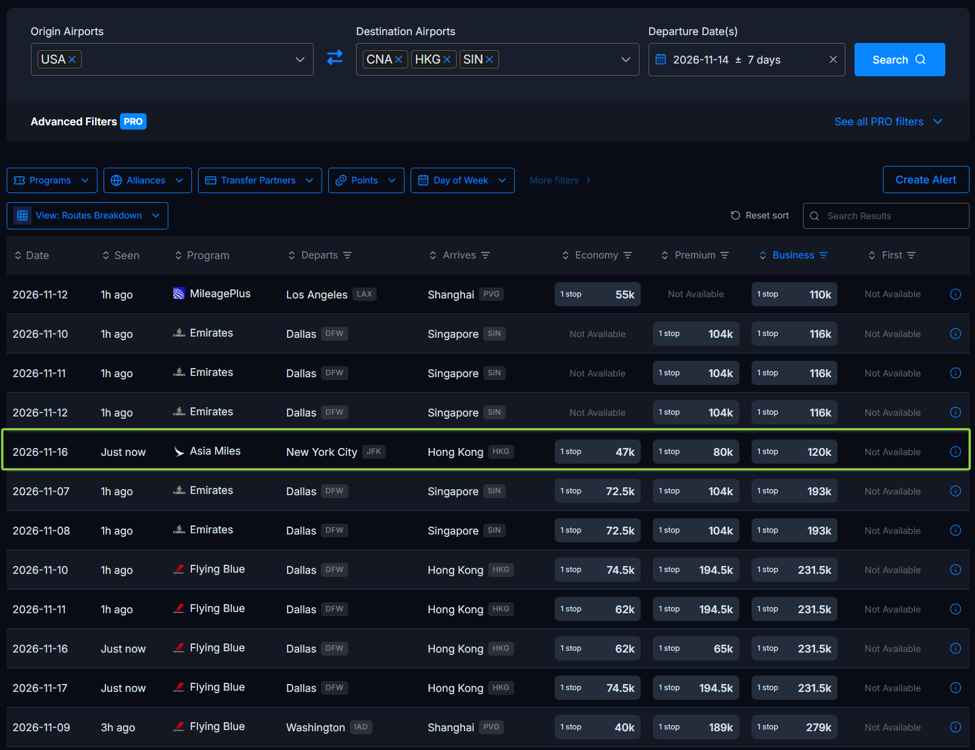
Award availability on an award finder. The JFK–HKG flight on 11/16/2026 is highlighted.
Step 1: Collect the prices
After identifying the route, date and airline of interest and confirming award space on the airline’s own search, it’s time to locate the cash prices. Specifically, we need three of them:
- The cash co-pay on each award. Award tickets usually still carry taxes and fees paid in cash.
- The cash price of each award ticket, so we know what the same seat would cost if bought outright. If the award seat isn’t sold for cash, or its cash price is too inflated to be meaningful, I use the cheapest same-day ticket in the same cabin from the same airline instead. In doing so, I also try to prioritize the same plane model because different variants can have different seats and layout.
- The cash price of the realistic alternative: usually an economy ticket on the same flight, or otherwise the cheapest option that day. This is what it costs to achieve the primary objective, which is getting from point A to point B.
For this example, the prices at the time of writing were:
Cabin | Award miles | Award co-pay | Cash price | Headline CPP |
Economy | 38,000 | $218.12 | $881.10 | 1.74¢ |
Premium economy | 78,000 | $218.12 | $2,181.10 | 2.52¢ |
Business | 120,000 | $236.90 | $6,266.60 | 5.02¢ |
The headline CPP in the last column is the classical formula: (cash price − award co-pay) ÷ award miles. For business, that is ($6,266.60 − $236.90) ÷ 120,000 = 5.02¢ per mile.
Two things are worth noting. First, the miles and co-pays shown on a third-party award finder can differ from what the airline actually charges, so always confirm on the airline’s website. Here, the finder listed 47K and 80K for economy and premium economy, while Asia Miles priced them at 38K and 78K. Second, in this particular example, award prices climb almost linearly with the cabin, but cash prices do not, so the headline CPP climbs from 1.74¢ in economy to 5.02¢ in business. This is why premium cabins are so often called the best use of points. The rest of this post puts that claim to the test.
Step 2: Calculate the origin-point requirement
The prices above are already enough to calculate the redemption CPP. However, our points usually come from a credit card program, and we must transfer them to the airline before booking. So we also need to understand the transfer ratio, any promotional transfer bonus, and the transfer terms.
Take the economy award as an example. It costs 38K Asia Miles. If we currently have no Asia Miles, all 38K must originate from our card. The card program’s transfer page shows the terms:

The ratio is 1,000 card points to 800 Asia Miles (1:0.8), and transfers must be made in 1,000-point increments. So although we mathematically need 38,000 ÷ 0.8 = 47,500 card points, we must transfer 48,000. Airline miles are generally less flexible than card points and can expire, so the extra 500 points may never provide any economic benefit. The calculator therefore counts them as spent. The business award needs exactly 120,000 ÷ 0.8 = 150,000 card points, so no rounding applies there.
Dividing the value by card points instead of airline miles gives the origin-point CPP: the monetary value each of our card points actually delivers.
Step 3: Consider the opportunity cost
When we book with points instead of cash, we also give up the points we would have earned by paying cash. That is the cash we save (the realistic price minus the co-pay, which we pay either way) multiplied by the card’s earn rate. Using the economy award again and assuming a 5x card, the opportunity cost is 5 × ($881.10 − $218.12) = 3,315 card points. Adding these to the denominator of the CPP formula gives the net CPP after opportunity cost.
Reading the results
Now I enter the business award as the redemption and the economy fare as the realistic alternative. Using R = award miles, P = same-class cash price, F = award co-pay, A = realistic alternative price, O = card points transferred and E = card points given up, the calculator walks from the classical formula to the net figure:
- Redemption CPP, same-class (classical): (P − F) ÷ R = $6,029.70 ÷ 120,000 = 5.02¢
- Redemption CPP, realistic: (A − F) ÷ R = $644.20 ÷ 120,000 = 0.54¢
- Origin-point CPP, same-class: (P − F) ÷ O = $6,029.70 ÷ 150,000 = 4.02¢
- Effective CPP: (A − F) ÷ O = $644.20 ÷ 150,000 = 0.43¢
- Net effective CPP: (A − F) ÷ (O + E) = $644.20 ÷ (150,000 + 3,221) = 0.42¢
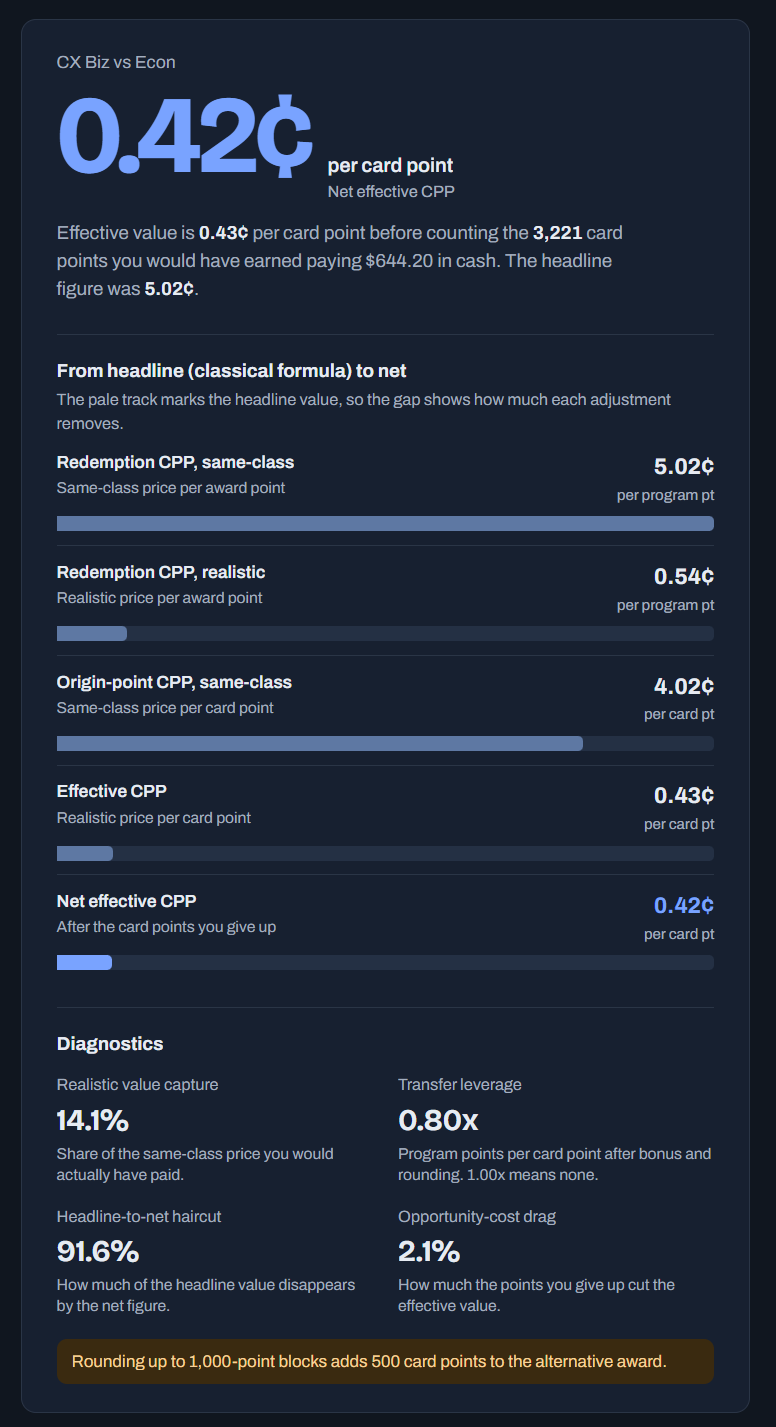
Using the classical approach, the 120,000-mile business award looks like 5.02¢ per point. Priced against the economy fare we would realistically have bought, and net of the card points we give up by not paying cash, it is worth 0.42¢, a 91.6% haircut. Most of that gap comes from a single question: would we really have paid $6,266.60 for this seat? The transfer ratio and the opportunity cost matter far less. Whether the seat is still worth it depends on what it is worth to you, but the point is that we are now much better informed about its value.
Comparing the two awards
The calculator also compares the redemption against booking the alternative as an award. This helps answer two different questions:
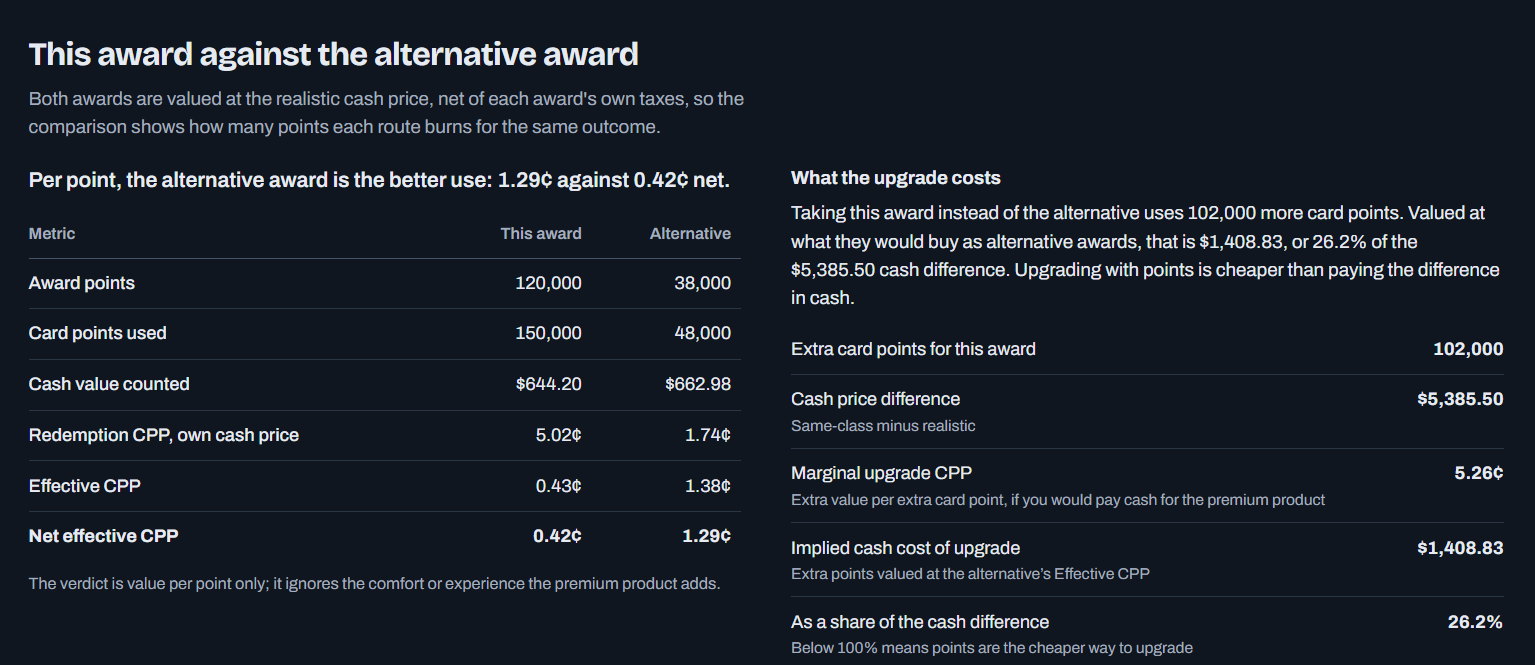
Which award gets the most value out of my points? Valued at the same realistic price, the economy award nets 1.29¢ per card point against 0.42¢ for business, about three times as much. If getting the maximum monetary value out of the points is the goal, the economy award wins.
If I just want to fly business on this flight, should I pay for it with points or cash? Business costs 102,000 more card points than economy. At the 1.38¢ those points would earn as economy awards, that is about $1,409 of value, only 26.2% of the $5,385.50 cash difference between the two fares. Put another way, each extra card point buys 5.26¢ of extra fare (the marginal upgrade CPP). In this example, points are clearly the cheaper way to pay for the upgrade.
Sensitivity
Finally, three inputs that drive the result can change over time:
- Promotional transfer bonuses, which card programs offer from time to time
- The cash-spend earn rate (card multiplier), which depends on the card and any spending promotions
- The realistic price as a share of the same-class cash price, which moves with fares
These are worth a sensitivity analysis, especially when we plan travel far in advance. In this example, the earn rate barely matters: net effective CPP only moves from 0.43¢ at 0x to 0.40¢ at 15x. A 50% transfer bonus lifts it to 0.62¢. The realistic price matters most: if economy cost 40% of the business fare instead of 14.1%, effective CPP would be 1.51¢ even without a bonus. Combined with research on historical bonus and fare patterns, the sensitivity tables can help optimize the timing and outcome of both the transfer and the redemption.
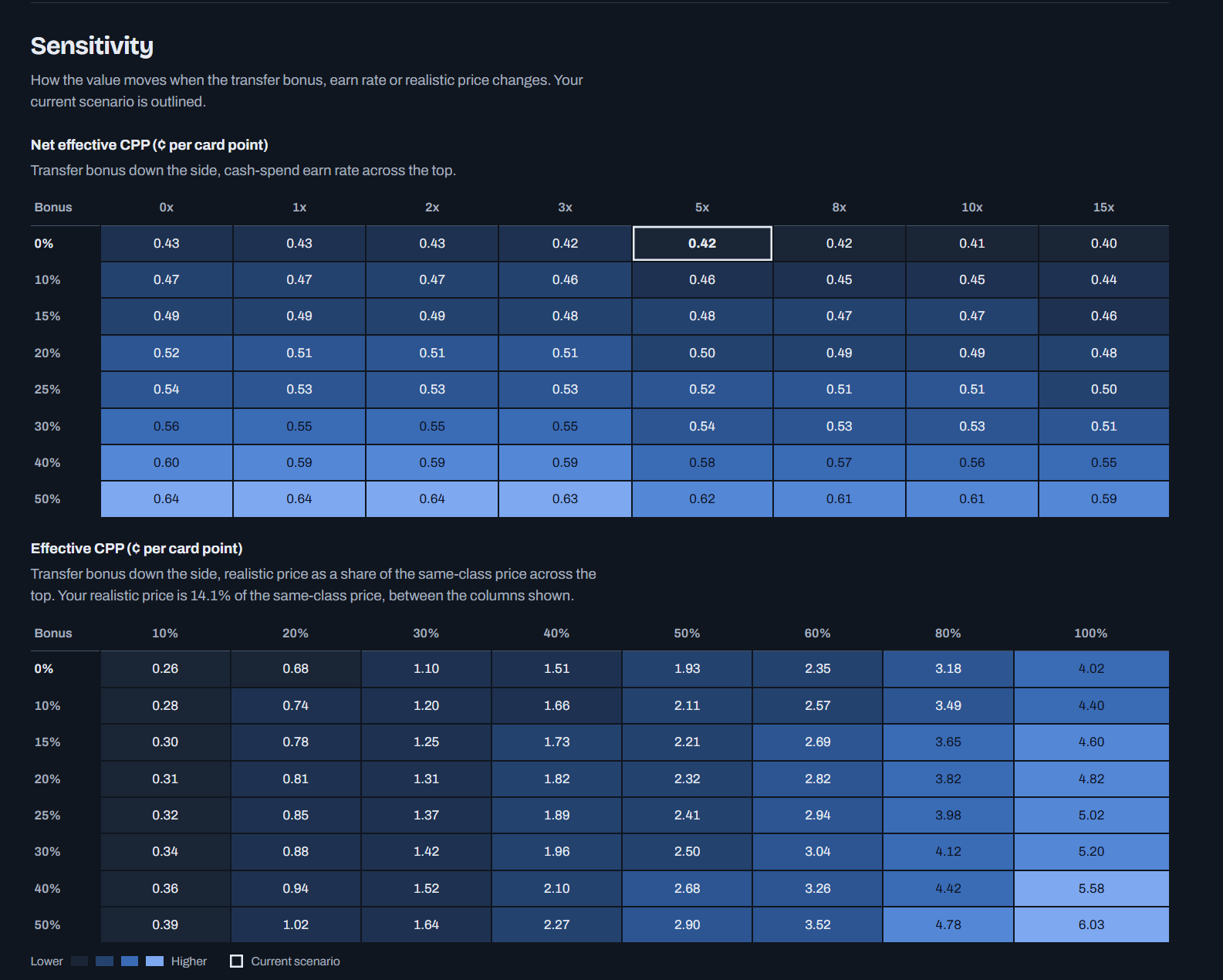
Sensitivity of net effective and effective CPP. The outlined cell is the current scenario.
Feel free to give my calculator a try and let me know what you think. 😎
Hopefully it helps with your travel plans! ✈️